

Introduction: The Evolution of Flexible Packaging and Why CI
In the hyper-competitive world of modern packaging, brand owners demand absolute color consistency, razor-sharp graphics, and lightning-fast turnaround times. Having spent over fifteen years on the production floor overseeing large-scale packaging runs, I have witnessed firsthand the struggles of managing web tension and registration errors on inferior equipment. If your production line is plagued by registration shifts or slow throughput, the definitive solution lies in upgrading to a central impression (CI) system. Utilizing a modern CI Printing Machine is no longer just an operational upgrade; it is the industry gold standard for high-speed, high-precision flexible packaging production.
Choosing a high-performance ci flexo press addresses the core challenges of printing on unstable, stretchable substrates like PE, BOPP, and thin papers. Unlike traditional stack presses, a ci flexo machine anchors the substrate firmly against a single, massive central impression cylinder. This engineering choice completely eliminates the material stretching that ruins print quality, allowing for flawless ci flexo printing execution at speeds exceeding 400 meters per minute. When you invest in a premium ci printing press, you are not just buying hardware; you are adopting a predictable, highly repeatable manufacturing solution that minimizes waste and maximizes your bottom line.
Section 1: Demystifying the CI Printing Machine: What It Is and How It Works
To truly understand the value of a CI Printing Machine, one must look closely at its mechanical physics. The defining characteristic of a ci flexo machine is its central impression drum, around which multiple color stations (typically 4 to 10 colors) are arranged radially. As the web material enters the ci flexo press, it is pinned tightly against this single, temperature-controlled steel drum. Because the material remains locked to a single surface throughout the entire multi-color process, there is zero opportunity for the substrate to stretch, shift, or distort between color applications. This structural rigidity is exactly why ci flexo printing delivers such incredible graphic fidelity, even on ultra-thin, extensible films.
From my years of fine-tuning these systems, I can tell you that the magic of a premium ci printing press lies in its synchronization. Advanced direct-drive servo motors control each individual print deck and the central drum with micro-metric precision. Computerized register control systems continuously read registration marks on the fly, making real-time micro-adjustments without slowing down production. This level of automated control means that once the job is set up, the machine maintains perfect alignment from the first meter to the last, dramatically cutting down on setup waste and labor costs.
Section 2: The Core Advantages of a Modern CI Flexo Press
When evaluating a long-term capital investment for your plant, the operational metrics of a CI Printing Machine consistently outperform alternative printing methodologies. Over my years managing high-volume shifts, the most glaring contrast between a ci flexo press and an inline or stack configuration comes down to waste reduction and material versatility. Because a ci flexo machine locks the substrate onto a shared central cylinder, it easily handles ultra-thin, extensible, and slippery films like 12-micron BOPP or breathable PE used in personal hygiene products. Trying to run these sensitive materials on a stack press often results in a nightmare of web wrinkles, high material scrap rates, and constant operator frustration.
Furthermore, the modern ci flexo printing workflow is engineered for rapid job turnarounds, which is essential in today's market of shrinking run lengths. A top-tier ci printing press features advanced sleeve-change technology, allowing operators to swap out plate cylinders and anilox rollers in mere minutes without tools. Combined with central computerized recipe management, this reduces setup times by up to 50% compared to legacy machines. By maximizing your uptime and dramatically slashing your ink and substrate waste during make-ready, this technology directly elevates your plant’s profitability and competitive edge.
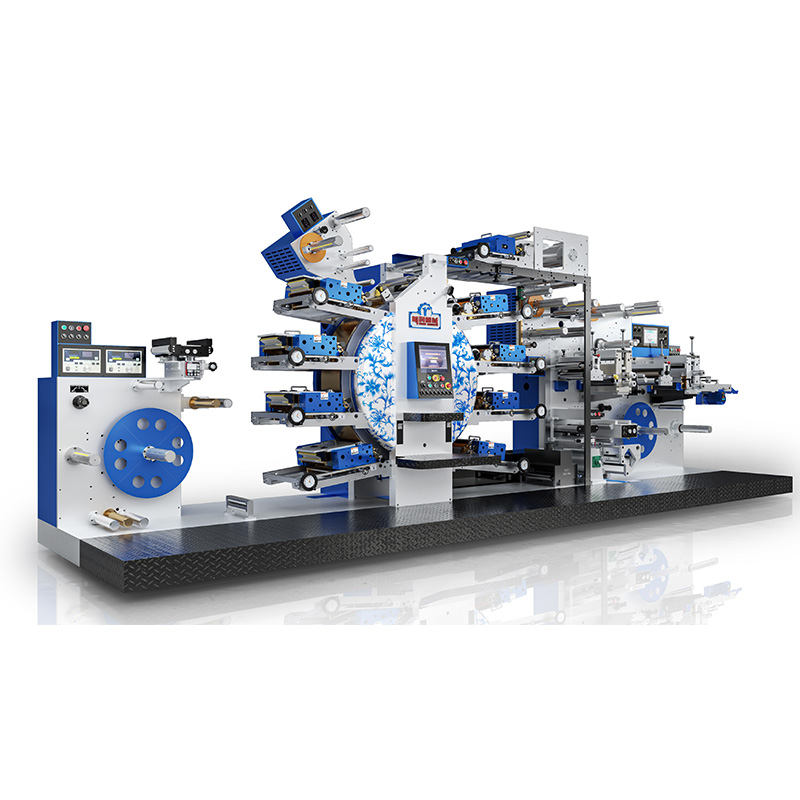
Section 3: Key Components That Drive Excellence in CI Flexo Printing
An elite CI Printing Machine is a symphony of high-precision components working in perfect harmony. At the heart of the ci flexo machine is the massive central impression cylinder, which must be precision-ground and dynamically balanced, featuring internal water circulation to maintain a perfectly stable surface temperature. Any temperature fluctuation can cause microscopic thermal expansion, throwing off your alignment. Surrounding this drum are the color decks, where the high-performance ci flexo press utilizes closed-chamber doctor blade systems. These chambers deliver a continuous, pressurized supply of ink to the ceramic anilox rollers, eliminating ink spitting and solvent evaporation, ensuring absolute color consistency across a 100,000-meter run.
Another critical component that defines modern ci flexo printing is the heavy-duty framing and deck movement mechanism. Premium ci printing press manufacturers utilize cast iron frames that absorb micro-vibrations generated at high speeds. The print decks move on high-precision linear guides controlled by absolute servo motors. This allows the machine to apply precise "kiss-touch" impression pressure between the plate sleeve, the substrate, and the anilox roller. This exact control prevents dot gain from blowing out your highlights, allowing your shop to cleanly print high-line-screen process work that rivals gravure quality.
Section 4: The Ultimate Purchasing & Implementation Solution for Businesses
Investing in a CI Printing Machine requires a strategic blueprint to ensure rapid return on investment and zero integration friction. Based on deploying multiple lines across various facilities, the first step in a successful solution is a rigorous substrate and ink compatibility audit. You must define whether your primary mix consists of water-based inks for paper, solvent-based inks for plastics, or UV/LED curable inks for high-barrier food packaging. Your chosen ci flexo press configuration must match this drying requirement, incorporating high-capacity between-color drying tunnels and an efficient central bridge dryer to completely eliminate solvent retention before rewinding.
The second phase of the implementation solution revolves around automation and operator cross-training. When acquiring a new ci flexo machine, prioritize models equipped with automatic pre-register and impression setting systems. These systems use smart cameras or sensors to scan test targets during the first few revolutions, automatically adjusting the decks into perfect register. This shifts the reliance away from rare, highly specialized master operators toward standardized digital control. Lastly, ensure your facility features proper climate controls and a dedicated clean-room area for your mounting machine, as perfect plate mounting is the foundation of flawless ci flexo printing. By treating the purchase of your ci printing press as an integrated ecosystem—combining proper drying, automated registration, and precision plate mounting—your business will hit peak efficiency within weeks of installation.
Section 5: Troubleshooting and Maintenance for Maximum Up-time
From the perspective of a floor manager, maintaining a CI Printing Machine in peak mechanical health is a daily discipline. The most common issue operators face during high-speed ci flexo printing is gear marking or barring on the print samples. On a modern gearless ci flexo press, this is rarely a mechanical gear issue; rather, it is often caused by micro-vibrations due to worn bearing mandrels or incorrect plate sleeve tolerances. Implementing a strict preventative maintenance schedule where mandrel runout is measured monthly with digital dial indicators will save you thousands of dollars in ruined substrate rolls and avoid costly emergency stops.
Another critical maintenance pillar for your ci flexo machine is the care of the central drum surface and the ceramic anilox rolls. The massive central drum of your ci printing press must be wiped down daily using approved non-corrosive solvents to prevent microscopic ink buildup, which can alter the cylinder's diameter and cause localized registration drift. For anilox rolls, manual cleaning is rarely enough to maintain consistent cell volumes. I highly recommend implementing an automated ultrasonic or baking soda blasting cleaning system. Clean cells ensure exact ink transfer, eliminating the frustrating color fading issues that often plague poorly maintained production lines.
Conclusion: Investing in the Future of Flexible Packaging
Transitioning your packaging operations to an advanced CI Printing Machine environment is the single most effective way to guarantee world-class print quality, slashing your operating waste while maximizing throughput. By selecting a highly automated ci flexo press tailored to your specific substrate mix, and protecting that asset with a proactive maintenance strategy, your plant can secure a definitive competitive advantage. Embracing high-efficiency ci flexo printing positions your company to easily meet the stringent, fast-paced demands of global brands, ensuring long-term profitability and sustainable manufacturing success.