

Introduction: The Evolution of Modern Flexography
In the fast-paced world of high-volume packaging, the Flexo Printing Machine stands out as an irreplaceable powerhouse. Often referred to interchangeably as a Flexographic Printing Machine or a Flexo Press, this technology has evolved from simple rubber-stamp printing into a highly sophisticated, computer-controlled manufacturing process. Whether you are producing flexible food pouches, corrugated shipping boxes, or high-end labels, choosing the right Flexographic Press directly impacts your production yield and bottom line. As a modern Flexo Printer, staying ahead of market demands means understanding how to leverage this high-speed rotary printing method to achieve pristine graphic quality on almost any substrate imaginable.
Chapter 1: Understanding the Core Mechanics: How a Flexo Printing Machine Works
To maximize the efficiency of a Flexo Printing Machine, operators must deeply understand its mechanical workflow. The process begins at the unwind station, where the substrate is fed into the Flexo Press under precise tension control. The heart of the Flexographic Printing Machine lies in its inking system, which typically consists of an anilox roller, a doctor blade chamber, and a plate cylinder.
The anilox roller, engraved with microscopic cells, carries a precise volume of ink. The doctor blade scrapes away excess ink, ensuring only the exact volume remains within the cells. This ink is then transferred to the flexible photopolymer plates mounted on the plate cylinder, which finally kisses the substrate against the impression cylinder. Achieving a flawless print requires fine-tuning the pressure—often within a tolerance of +/-2μm—to avoid dot gain and ensure crisp text and vibrant images.
Chapter 2: Key Benefits of Investing in a High-Speed Flexographic Press
Investing in a modern Flexographic Press offers unparalleled competitive advantages for B2B packaging suppliers. The primary benefit is blistering production speed, with high-end machines comfortably running at 400 to 600 meters per minute. Unlike offset or gravure setups, a modern Flexo Printing Machine handles a vast array of materials, including non-porous plastic films (BOPP, PET, PE), aluminum foil, heavy kraft paper, and linerboard.
Furthermore, from a cost-per-print perspective, a Flexographic Printing Machine becomes exceptionally economical during long-run jobs. The durability of modern photopolymer plates allows for millions of impressions before requiring a replacement, significantly reducing operational downtime and boosting overall factory throughput.
Chapter 3: Choosing the Right Configuration for Your Business
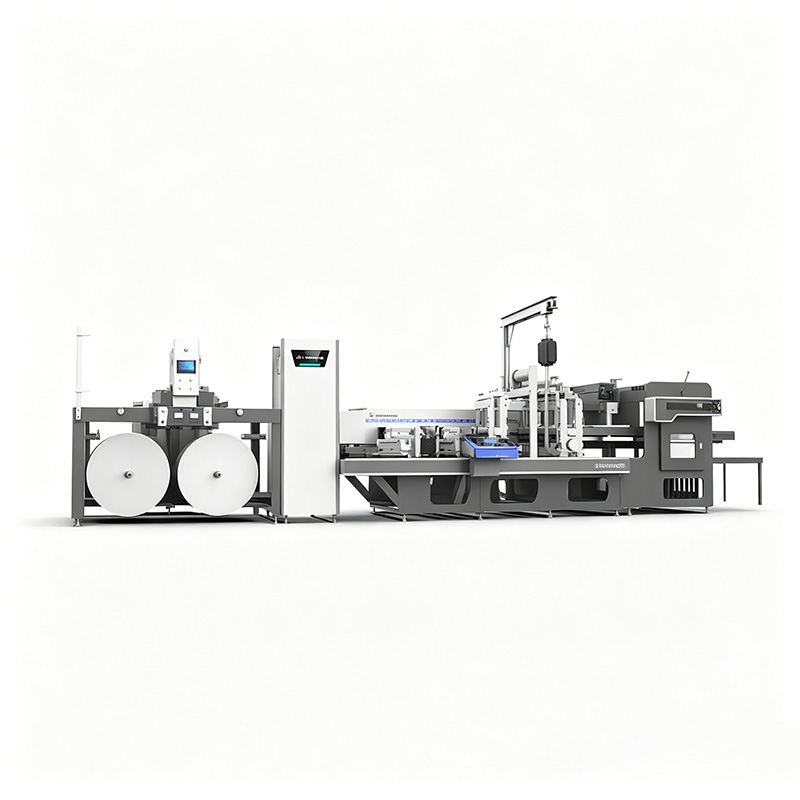
Not all printing challenges are identical, which is why a Flexo Printer must select the correct machine configuration based on their target market. There are three primary architectures available:
| Machine Type | Best Suited For | Key Advantage |
| Central Impression (CI) | Thin, stretchable plastic films | Perfect registration control due to a single large impression cylinder. |
| Inline Flexo Press | Labels, tags, and thick folding cartons | Allows multiple finishing processes (die-cutting, laminating) in one pass. |
| Stack Type | Short runs, dual-sided printing, and coatings | Easy access to print stations and flexible web pathing. |
For flexible food packaging, a CI Flexographic Printing Machine is the gold standard because it prevents material stretching. For industrial labels or heavy-duty packaging, an inline Flexo Printing Machine provides the best multi-process efficiency.
Chapter 4: The Ultimate Solution: Optimizing OEE and Solving Common Printing Defects
To deliver a complete solution for factory owners, optimizing Overall Equipment Effectiveness (OEE) on your Flexo Press is essential. Based on years of on-site floor experience, here is a professional troubleshooting guide and solution matrix to eliminate common printing defects:
● Misregistration: Ensure your tension control system is calibrated within a tolerance of 0.1 N. Implement automatic camera-based register control systems to adjust the plate cylinder positioning in real-time.
● Ink Spitting: Often caused by doctor blade micro-vibrations at high speeds. Upgrade to a stiffer, radiused-edge carbon steel blade and optimize ink viscosity to 22-25 seconds (Zahn Cup No. 2).
● Preventative Maintenance Blueprint:
1. Daily: Clean the anilox roller immediately after every run using specialized ultrasonic systems or chemical agents to prevent dried ink from plugging cells.
2. Weekly: Check gear backlash and lubricate all moving bearings on the Flexographic Printing Machine.
3. Monthly: Verify the dynamic balance of the plate cylinders and check the accuracy of the heating/drying tunnels.
By integrating smart digital controls and automated plate-mounting hardware into your workflow, your Flexo Printing Machine setup can achieve a 30% reduction in setup time and minimize material waste during job changeovers.
Conclusion: The Future of the Flexo Printer Industry
As global regulatory pressure shifts toward greener manufacturing, the modern Flexo Printer must adapt. The transition toward water-based eco-friendly inks and recyclable monomaterial substrates is reshaping how a Flexographic Press is operated. By combining these sustainable materials with high-efficiency automation, your facility can meet strict environmental standards while maintaining excellent profit margins. Embracing these advanced configurations guarantees that your investment in a Flexo Printing Machine remains future-proof for decades to come.